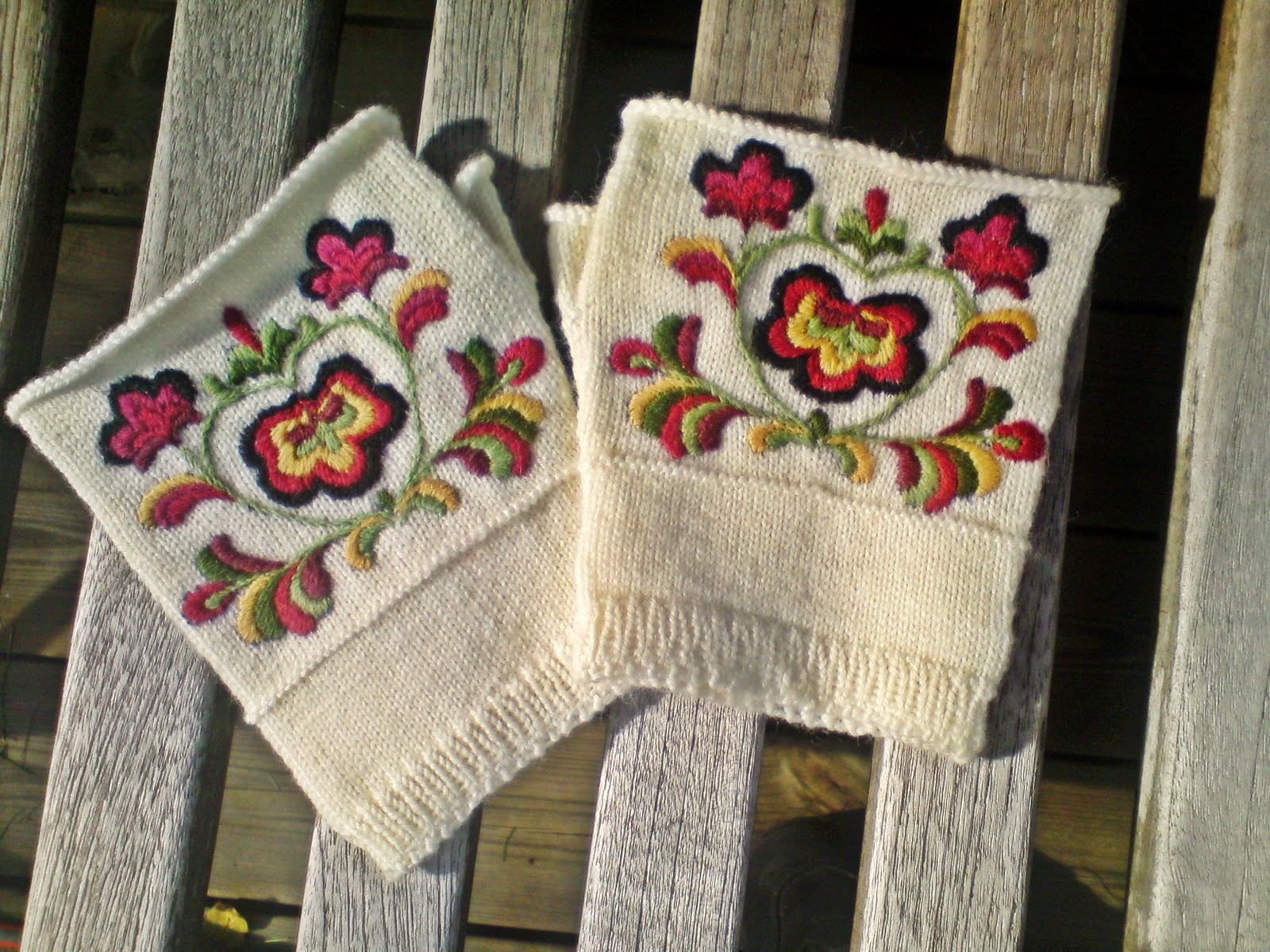
I found this fantastic book called "Hand garments for bunads" (Norwegian title: Håndplagg til bunader og folkedrakter) by Heidi Fossnes. The author had travelled around the country, visiting museums all over Norway, making copies of old hand garments. The book includes the story of the original mitten, with pictures of it, as well as patterns for (and pictures of) the reproduction. This book is a must have (if you can read Norwegian).
I made one pair of fingerless mittens from Ål in Hallingdal and wrote a blog about it. Right before Christmas, I got a comment to the blog from a lady who was responsible for purchases for a film. She asked me if I could help her make a couple of mittens, which I would love to.
I Googled her, and it turned out that she had partisipated in several large Hollywood productions. Luckyly, I did not know this when I agreed to help her. Not that I would not have helped her anyway, but it makes the conversation more relaxed when you do not know (I have a tendency to be star struck). I do not know what the film is about. My ten year old daughter is nagging me to find out. I guess I have to ask her in my next mail......
She wanted five mittens: four fingerless mittens and one pair of large driving mittens (which they used in the old days driving a hourse and sledge). I am going to use the embroidery from most of the mittens I have included a picture of in this blog (all the pictures included are from Heidi Fossum's book), only sewn on to fingerless mittens in stead of mittens and gloves. However, several of the mittens will look like the original, inkluding the large driving mittens.
I am off to a good start. All the mittens are now made, and I have finished the embroidery on more than half of them. At the moment, I am embroidering the driving mittens. When I was at it, I decided to make a couple of extra mittens (mainly for my own satisfaction). I have finished five pairs of fingerless mittens, and I have made two more pairs which need to be embroidered (in addition to the driving mittens). Then, she can choose whomever she wants. I have also varied the size of the mittens, giving her more choices.
I will write a series of blogs describing these mittens. Hopefully, I find out what kind of movie she is working on. If I am lucky (and my work is good), some of my mittens will get a new life in sunny California.
In this blog I will write about all my favorite projects, doing things I love to do; knitting, quilting, crocheting and sewing.
Tuesday, 24 January 2012
Friday, 20 January 2012
Mini-Finn
Here comes the last Mini-Me I have made for my colleagues. This is Mini-Finn. The only one left now is I. Maybe I will make a copy of myself as well. A real Mini-Me........ .
Finn loves quizzes. He is a living encyclopaedia, and remembers a impressive amount of trivia. He is also exceptionally good at calculus in the head. Every day in the lunch room, when we sit and discuss various topics over lunch and need some facts, we only have to ask Finn. What he does not know the answer to, he will find out on his i-phone. In the purple sofa (in the lunch room) with his i-phone, he is Encyclopaedia Aune (Aune is his last name)Mini-Finn sits in his purple sofa with an i-phone in his hand. Mini-Finn is like the other Mini-Me dolls a modification of Beth Webber's doll "Mini Free Spirit". You can find patterns to this doll (and much more) on her blog "By hock by hand". The hair is made out of two types of flossy yarn, one brown and one grey. The eyes are from Sunchatcher Eyes, and the doll is crocheted in an acrylic yarn I found on Craft designs 4 you, called Red Heart Super Saver.
The sofa is made from cardboard, which is folded and covered with purple crocheted "fabric". The plates on the side of the sofa are stitched on afterwards, to make the sofa more stable. The floor is crocheted in a yarn called Østlandsgarn. The sofa is stitched on to the floor, and I have treaded on a metal flower stick in the back of the sofa (which is threaded onto the dolls sweather), so that Mini-Finn may sit safely on the sofa without the fear of falling off. The i-phone is made of a pie of a black coaster.
Mini-Finn was given to his new master before Christmas, and was received well. Now, he is situated in the office of his namesake, in his own purple sofa, playing with his i-phone.
Friday, 6 January 2012
Mini-Per-Arild
The second Mini-Me I made of one of my male colleagues for Christmas was Mini-Per-Arild. Per-Arild is the oldest of my colleagues. He is very generous, and shares all his knowledge, contacts and ideas gladly. He bakes cakes for his father in law, and brings cake leftovers to work. He is also very good at getting founding for all his projects, and those of my colleagues who work with him seldom lack financing.
Due to Per-Arild’s good qualities, I wanted to picture him as "the seventh father in the house". This is a character from one of Norway’s favourite fairytales, about a vagabond who seeks food and shelter for the night. He comes to a house, and asks the first male he sees. He is refused with the explanation that it is not his decision, because he is not the father in the house. The vagabond is asked to ask his father. And for each father he is asking (who gets older and older, and smaller and smaller), he gets the same answer: "It is not my decision. Ask my father." Finally, he finds the seventh father in the house, who is this ancient tiny death old man in a cow's horn up on the wall. He almost gives up, but still asks him. When he finally gets him to understand (by using mime), suddenly every thing works out, and he gets as much food as he could ask for and a nice bed to sleep in.Mini-Per-Arild is, as the other Mini-Me's, a modification of Beth Webber's doll "Mini Free Spirit". You can find the pattern for this doll at her blog "By hock by hand". The hair is made by using two different flossy yarns: one brown and one grey. The eyes are from Sunchatcher Eyes, and the doll is crochet in an acrylic yarn called Red Heart Super Save that I bought at Craft designs 4 you.
I could not help myself: I just had to add a couple of distinctive features about Per-Aril, such as his little bald spot. He also has this bright pink sweeter. He is one of the few men approaching 70 that I know of (in Norway) that dares to wear pink, and I think it is fantastic
Unfortunately, I did not have a picture of Per-Arild for comparison.... Sorry.
Monday, 2 January 2012
A forest model
One of my main projects this year has been to make a mini version of all my female colleagues for their birthday (see the Mini Me series). For Christmas, I made a Mini-Me version of all my male colleagues as well. Here is the first: Mini Bjart. Or rather Mikro Bjart.
Bjart is very brave when it comes to public discussions. He braves the storm where all his other colleagues would not dare to go out of their office. His largest dispute until now was probably the question of whether increased use of solid bio fuels for residential heating is good for the environment or not. He was verbally abused by both cabinet ministers and other researchers, but in the end, he proved them all wrong.
Thus, I found it appropriate that Mikro-Bjart went for a stroll in his forest, just as the real Bjart loves to go hiking. This is his world, where he belongs.
Weeping Willow alpaca cardigan
I have two passions in life with respect to knitting: to knit with alpaca yarn and lace knitting. I wanted to combine the two in a sweater. I came up with this jacket, knitted in Tynn Alpakka from "Du store alpakka".
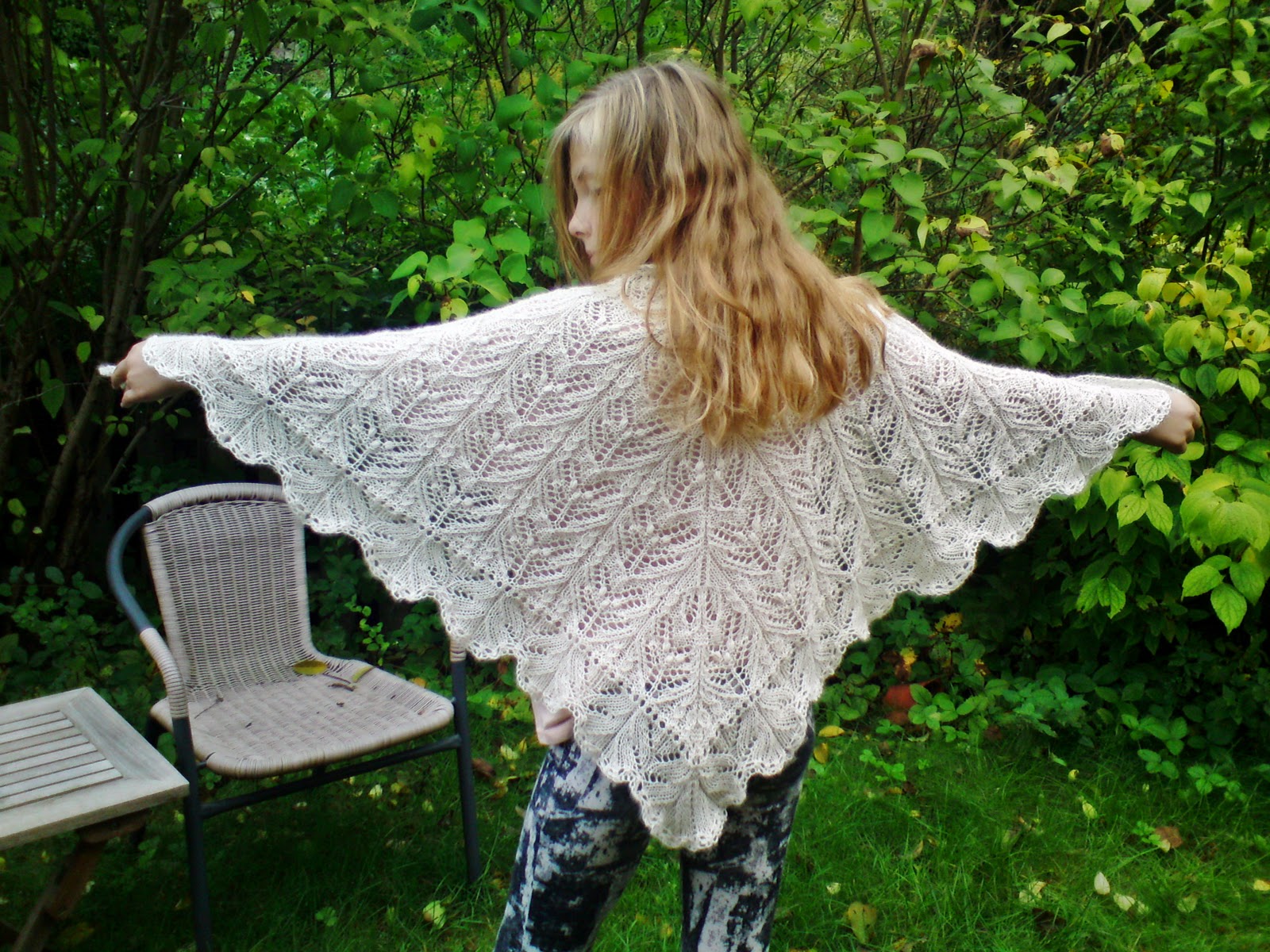
It is based on one of my favorite patterns from the Estonian tradition of lace knitting. The pattern is called Weeping Willows. I have used it before, for the Weeping Willow shawl, and I thought it would make a nice pattern for a cardigan. Or rather, I actually started on the jacket firs, last winger. I did not finish before the spring came, and I did not finish it until this fall, after making the shawl.
The reason why the cardigan was not finished was that it became a bit too large, because I did not account for the increase in length after the pattern was blocked out. I did account for the blocked gauche with respect to how many stitches to use, but forgot it when it came to how many repetitions of the pattern I needed. As a result, the sleeves became too long. I solved this problem simply by taking them up a bit. Then, I crochet the edging afterwards. It became OK, although not great.
My aim is to write the pattern down, for other to be able to knit the cardigan if they want to. It takes some time to write out my notes, but I hope it will be finished within a couple of weeks, at least for a Norwegian version of the pattern.
Monday, 5 December 2011
Alpaca sweater
Here is a sweater I have knitted this autumn. It is an old fashion ribbed sweater with a high neckline, knitted in alpaca wool. I simply love these sweaters. They are warm, easy to knit with a very classic design.
The sweater is knitted in Tynn Alpakka from "Du store alpakka". I found the pattern free of charge on "Du store alpakkas" web-page. You can find the pattern in this number of Strikk (pattern nr. 9). Unfortunately, the pattern is only in Norwegian, but with the help of Google, it should be possible to follow.
This is the second time I have knitted this sweater. I have knitted it in grey before (as in the pattern). I also knitted the shawl in design 10, which goes with this sweater. It is very soft and warm, and is a good every day shawl. I definitely recommend knitting both the sweater and the shawl. They are easy to knit and warm to wear.
Friday, 28 October 2011
Damask
I found a beautiful shawl called Damask on one of my favourite blogs, A passion for knitted Laces. It was one of a series of beautiful shawls designed by Kitman Figueroa. I immediately fell for this shawl, and I just had to make.
In the pattern, a smooth shiny yarn was used. However, I wanted a warm and fuzzy yarn, so I knitted the shawl in an alpaca yarn called Tynn Alpakka, from Du store Alpakka. It is a lovely yarn to knit, and it gives a very soft, warm and snug shawl.
The shawl is relatively easy to knit, much easier than it looks. Also, due to the thick yarn, it does not take a long time to finish. I truly recomend to try this pattern. It is not as hard as it looks, and the pattern is easy to follow.
Tuesday, 18 October 2011
My second Peacock Shawlette
I have knitted a series of shawls designed by Kitman Figueroa. The first shawl I made was called "Peacock Shawlette". I really liked to knit my first peacock shawlette, so I just had to make one more. This shawl I made in a yarn called Fin fra Du store Alpakka, which is a lovely mix of baby alpaca and silk.
Making lace shawls was really easy using this yarn, and there are some lovely hand painted varieties. I have used one of these in this shawl, which is a mix of blue, turquoise and sea green. I really fell i love with this yarn.
This yarn makes the lace patterns very smooth, and I believe it is sufficient just to iron shawls using this yarn (even though I blocked this shawl out).
Making lace shawls was really easy using this yarn, and there are some lovely hand painted varieties. I have used one of these in this shawl, which is a mix of blue, turquoise and sea green. I really fell i love with this yarn.
This yarn makes the lace patterns very smooth, and I believe it is sufficient just to iron shawls using this yarn (even though I blocked this shawl out).
Wednesday, 28 September 2011
Fingerless mittens for bunads
It turned out that this was a treasure of a book, and I fall in love immediately. The author had travelled all over Norway, visiting museums, taking pictures of old mittens, gloves, wristlets and fingerless gloves (here after referred to as hand garment). Then she made a reconstruction of the old hand garments, making patterns. Most of the garments was from the mid to the end of the 19th century, but some were even older.
Many of these projects were incredibly beautiful, and photos of both the old garments and the new reproduction are presented in the book. I fell for many of then, among them these fingerless mittens from Ål in Hallingdal. There were no record of the age of these mittens, but you can find them in the museum in Drammen
Embroideries on knittings is actually harder to do than I expected, but after a while I got the hang of it. The big challenge was to transfer the embroidery pattern from the book to the mittens. The book suggests to do this by freehand, but I did not want to risk that. So I applied a technique from quilting, transferring quilt patterns. The trick is to make a copy of the pattern onto a piece of tulle fabric. Then you only need to go over the patterns with a pen, and the pattern will be transferred due to the holes in the fabric. My only problem was that all my fabric pens had dried out, so I used an ordinary felt pen instead. This resulted in some smearing, but despite this, it worked out well in the end.
This was my first attempt. I really liked it, so I will probably make more of the patterns in the book.
Friday, 23 September 2011
The Peacock Shawlette
Recently, I have knitted many thin lace shawls, both based on patterns from Estonia and Shetland. Now, I wanted to knit a shawl in a more thick yarn, to use as a scarf during the cold winter months. I found a series of patterns designed by Kitman Figueroa on the internet. I bought several, but the first one I tried was this, named "Peacock Shawlette".
The shawlette is knitted in an alpaca yarn called Tynn Alpakka from Du store alpakka. I tried to find a colour looking like a peacock, but the one I found was a little dark. In sunlight, however, the colour is beautiful, with a hint of green.I really enjoyed knitting this shawl, and it is very fast to do. I only used two evenings knitting this shawl. It is a great pattern to start with if you have not knitted lace shawls before. It was actually so fun, that I knitted four more when I first started. I will pose them on the blog during the fall. The plan is to give these shawls away for Christmas.
Finally, I would like to thank my daughter Elise, for being my model, even though she did not want to.
Subscribe to:
Comments (Atom)