Wednesday, 28 March 2012

Needle bound driving mittens

Here comes the last pair, and the jewel in the crown, of my series of mittens based on Heidi Fossnes' book "Håndplagg til bunad og folkedrakter". The original pair of mittens was found in Sauherad in Telemark. The original pair came to the museum in 1892, but they do not know exactly how old they are. They do, however, have a similar pair at the museum, which they know is from 1811, because it is embroidered on the back of the mittens. Thus, it is reasonable to believe that this pair is from the first half of the nineteenth century.

These mittens are made by an ancient technique called "nålbinding" (Norwegian) or needle binding (English). They have found garments made by this technique all the way back to the viking area, and even earlier. Needle binding is great fun and quite easy to do, when you get the hang of it. Basically, you are winding the yarn around your thumb, while you are anchoring it in the loop under and besides. This is an excellent technique to use on mittens, as it does not run. This makes the mittens easy to repair. On the other hand, it makes it extremely difficult to correct an error, as it is virtually impossible to unravel the work. The last point was a problem for me, as I had never tried needle binding before. On one occasion, I had to cut of an entire thumb to fix a problem.

Heidi Fossnes does not describe how to needle bind in her book, so I had to look it up on the Internet. It turned out not to be a problem, as there are several good instruction videos out there. You only have to search for "naalbinding" or "needle binding", and several alternatives pops up. I preferred this video. It is in German, but if you know some German (as I do) it is a very good instruction. For this project I used "der Oslo stitch", since it looked like this was the stitch applied in the original pair of mittens.

The mittens are made in PT 3, which is a thick wool yarn which is easy to felt. The mittens are relatively large when they are made (43 cm), but they shrink dramatically during the felting and is just over 30 cm when finished. The embroideries are made in a combination of cotton thread by DCM and a fine wool thread by Appelton, which I doubled in order for it to fill out the embroidery properly.

I could not use a fabric pen to draw the pattern on the mittens prior to the embroidery, since the felting made the drawings unclear. Thus, I needed to sew these mitten by free hand. Thus, I waited a while, to get some practise on the other mittens I made in this series of mittens (which was probably wise), before finishing the embroideries on these mittens.
In the book, there were almost no instructions on how to make the actual mittens, only a down scaled drawing of the outline of the mitten. Thus, I did not know how many stitches to cast on or how to increase or decrease to give the mittens its shape. This was a bit problematic, since needle binding is like knitting and crocheting: it tightens up after a couple of rounds. Thus, it took me several attempts to get it right (in particular considering the difficulties I had undoing what was already made). I have written down the pattern for the mittens I made, in order to make it easier the second time around.  You can download the pattern free of charge here. Unfortunately, the pattern is in Norwegian, but with the help of Google translator, I hope it will be possible to understand for non-Norwegians as well. Together with the book and an instruction video of how to do the needle binding, it should be possible to make these mittens. The embroideries are pretty hard to do, but the needle binding is easy when you get the hang of it. And the result is tremendously rewarding. Good luck!

Monday, 5 March 2012

Fingerless mittens with rose seam II


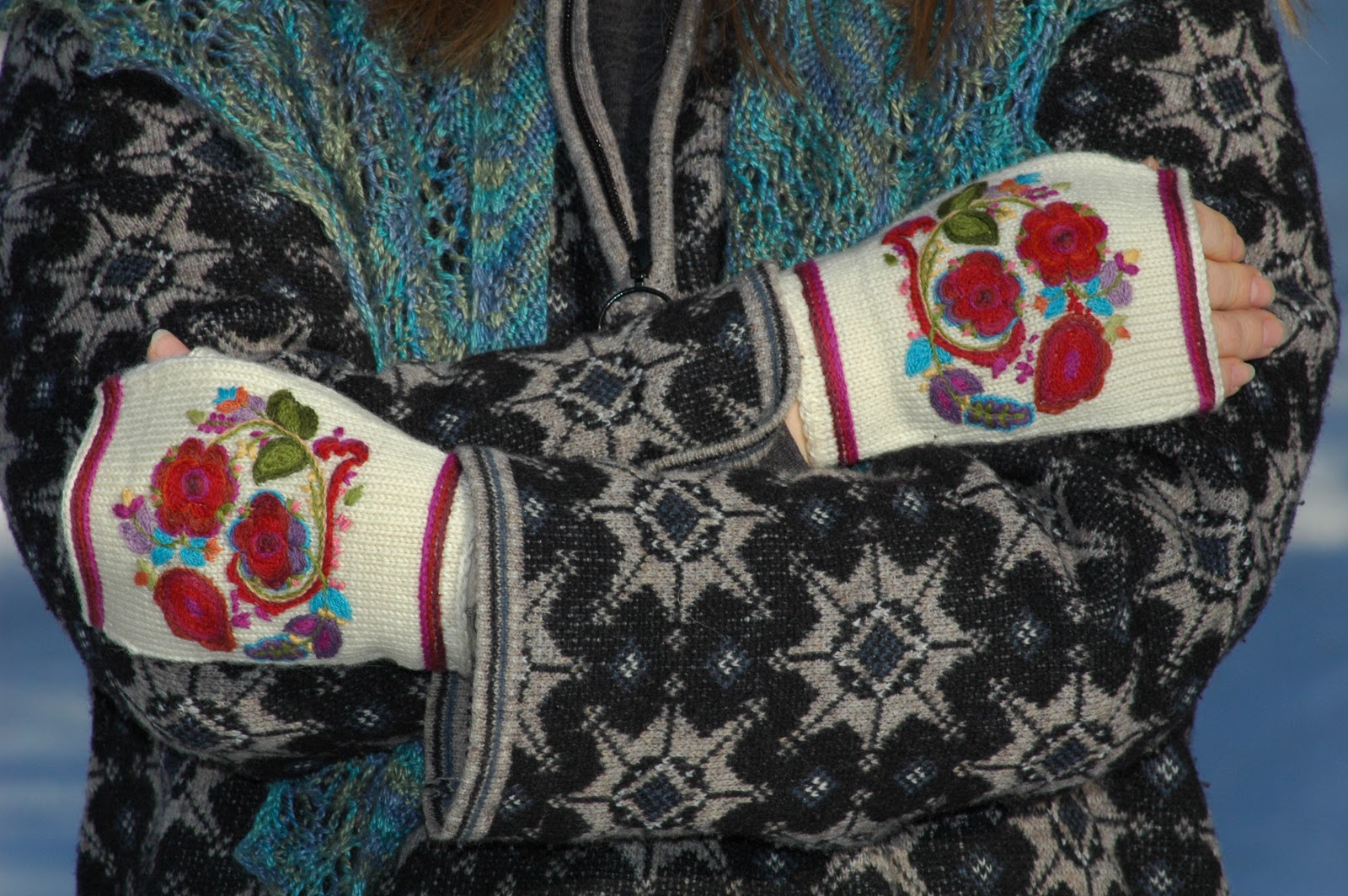
Here comes my favourite pair in this series of mittens based on Heidi Fossnes' book "Håndplagg til bunad og folkedrakter". Originally, this embroidery was sewn onto a pair of grey mottled gloves found on Vaalund farm in Tinn in Telemark. They do not know how old the gloves are, but they believe they are from the turn of the last century.

As I was making fingerless mittens for my film project, I used a pair of white mittens based on a pattern from Ål in Hallingdal as a background for this embroidery. My mittens are knitted using a thin yarn called Dale Baby Ull on needles number 1,5 mm. The embroideries are made in a fine wool thread from Appleton. In comparison with the other pair of fingerless mittens with rose seam, this thread worked very well on these mittens, because the area to fill in the embroideries was much smaller.

In the beginning, I did not notice this pattern in the book, because the embroidery kind of despaired in the mottled background. But when I saw the drawings, I figured that maybe they weren't so dumb after all. I had already finished the number of mittens that I had promised to make, but I had a skein of baby wool lying around, so I thought it might be worth while to give it a try. And I have not regretted this decision for a moment.
This is definitely my favourite pair. In particular, I love the straws curving slightly up towards the index finger. I am also pleased with the colour balance in the embroidery, and the little circle on the thumb, which I attached to give it some colour on the back of the mitten. And I also love the pictures my husband made for me.

Thursday, 1 March 2012

Fingerless mittens from Valle in Setesdal


Here comes yet another pair of fingerless mittens in my series of mittens based on Heidi Fossnes' book "Håndplagg til bunad og folkedrakter". The original pair was found on Løyland farm in Valle in Setesdal. They do not know how old these mittens are. You can find a picture of a reproduction of the original pair of mittens here.


These fingerless mittens are knitted in a yarn called Falk from Dale on 2 mm needles. The embroidery is done with a fine wool thread from Appelton. I doubled the thread to give the pattern more fullness.

I knitted two pair of mittens; one white pair and one black pair (like the original). The white pair was the first one I made, and the black pair was the last mittens I made in this series of mittens.

These were by no comparison the most difficult pair to make, despite that they looked strait forward. However, the angle of the stitches and the coarse knitted fabric made it virtually impossible to get the edges of the hart pretty and even.
Furthermore, on the black pair, I was not able to transfer the motif by tulle and fabric pen, as I was able to on the white pair. Thus, I needed to sew the pattern on the black pair by freehand.

These are not the pair that you start on the first time you try to make such mittens. They are far to difficult to make. But if you have some practice, and you get the angles right, they become really beautifull.


Tuesday, 28 February 2012

Fingerless mittens from Heidal

Here comes another pair of fingerless mittens in my series of mittens based on Heidi Fossnes' book "Håndplagg til bunad og folkedrakter". Originally, this embroidery was sewn on a pair of black mittens that was found in Heidal, in Nord-Gubrandsdalen. The original pair came to museum in 1911, so they are probably from the last half of the 1900th century. You can find a picture of a reproduction of the original pair of mittens here.

These fingerless mittens are knitted in a yarn called Falk from Dale. The pattern for the fingerless mittens is originally from another pattern in the book, and comes from Valle in Setesdal. The embroidery is done with a fine wool thread from Appelton. I doubled the thread to give the pattern more fullness.
This was a fairly easy and fast pair of mittens to make, and the embroidery was easy to get pretty even if the mittens are knitted in a relatively thick yarn with (in this context) relatively large needles (2 mm). The pattern was a bit too big for the fingerless mittens, but I made them go into the upper edge, which made them look pretty anyway. I highly recommend this pattern, even if it probably looks best on a black pair of mittens as in the original.

Monday, 20 February 2012

Fingerless mittens from Ål in Hallingdal

Here comes the next pair in my series of mittens based on Heidi Fossnes' book "Håndplagg til bunad og folkedrakter". The original pair came Ål i Hallingdal, and came to the museum in1892. They do, however, not know how old the mittens are.

My mittens are knitted in Dale Baby Ull on needles 1,5 mm.  The mittens are embroidered with a fine wool thread from Appelton.

These mittens are relatively easy to make compared to many of the other mittens, as the thin yarn and needles makes it easier to get the embroidery even. This is a good pair to start on, together with the other pair of fingerless mittens from Ål in Hallingdal that I have made, if you like to try to make these kinds of embroidered mittens for the first time.

Sunday, 12 February 2012

Fingerless mittens with rose seam


My latest project has been a series of fingerless mittens and driving mittens based on patterns from Heidi Fossnes' book "Håndplagg til bunad og folkedrakter". Here is the first pair. It is a couple of fingerless mittens with an embroidery of rose seam found on a pair of gloves from Tinn in Telemark. The original pair of gloves was found on Vaalund Gård, and is probably from around the turn of the century.


The mittens are knitted in a wool yarn called Falk from Dale. The pattern for the mittens is also from Heidi Fossnes' book, and originates from Valle in Setesdal. The rose seam is embroidered in a fine woll yarn from Appelton. There is an incredible amount of beutiful shades of colours, which made the task of finding the yarn for the embroidery easy.

The rose seam is sewn with contour stitches, also as fillings. This makes the embroidery almost three dimensional. You should probably use a thicker more hard spun thread for this kind of embroidery, but I did not find this kind of thread with sufficiently large array of colours in my local craft store.

Tuesday, 24 January 2012

My new mitten project

I found this fantastic book called "Hand garments for bunads" (Norwegian title: Håndplagg til bunader og folkedrakter) by Heidi Fossnes. The author had travelled around the country, visiting museums all over Norway, making copies of old hand garments. The book includes the story of the original mitten, with pictures of it, as well as patterns for (and pictures of) the reproduction. This book is a must have (if you can read Norwegian).


I made one pair of fingerless mittens from Ål in Hallingdal and wrote a blog about it. Right before Christmas, I got a comment to the blog from a lady who was responsible for purchases for a film. She asked me if I could help her make a couple of mittens, which I would love to.

I Googled her, and it turned out that she had partisipated in several large Hollywood productions. Luckyly, I did not know this when I agreed to help her. Not that I would not have helped her anyway, but it makes the conversation more relaxed when you do not know (I have a tendency to be star struck). I do not know what the film is about. My ten year old daughter is nagging me to find out. I guess I have to ask her in my next mail......


She wanted five mittens: four fingerless mittens and one pair of large driving mittens (which they used in the old days driving a hourse and sledge). I am going to use the embroidery from most of the mittens I have included a  picture of in this blog (all the pictures included are from Heidi Fossum's book), only sewn on to fingerless mittens in stead of mittens and gloves. However, several of the mittens will look like the original, inkluding the large driving mittens.

I am off to a good start. All the mittens are now made, and I have finished the embroidery on more than half of them. At the moment, I am embroidering the driving mittens. When I was at it, I decided to make a couple of extra mittens (mainly for my own satisfaction). I have finished five pairs of fingerless mittens, and I have made two more pairs which need to be embroidered (in addition to the driving mittens). Then, she can choose whomever she wants. I have also varied the size of the mittens, giving her more choices.


I will write a series of blogs describing these mittens. Hopefully, I find out what kind of movie she is working on. If I am lucky (and my work is good), some of my mittens will get a new life in sunny California.

Friday, 20 January 2012

Mini-Finn


Here comes the last Mini-Me I have made for my colleagues. This is Mini-Finn. The only one left now is I. Maybe I will make a copy of myself as well. A real Mini-Me........
 
.
Finn loves quizzes. He is a living encyclopaedia, and remembers a impressive amount of trivia. He is also exceptionally good at calculus in the head. Every day in the lunch room, when we sit and discuss various topics over lunch and need some facts, we only have to ask Finn. What he does not know the answer to, he will find out on his i-phone. In the purple sofa (in the lunch room) with his i-phone, he is Encyclopaedia Aune (Aune is his last name)


Mini-Finn sits in his purple sofa with an i-phone in his hand. Mini-Finn is like the other Mini-Me dolls a modification of Beth Webber's doll "Mini Free Spirit". You can find patterns to this doll (and much more) on her blog "By hock by hand". The hair is made out of two types of flossy yarn, one brown and one grey. The eyes are from Sunchatcher Eyes, and the doll is crocheted in an acrylic yarn I found on Craft designs 4 you, called Red Heart Super Saver.


The sofa is made from cardboard, which is folded and covered with purple crocheted "fabric". The plates on the side of the sofa are stitched on afterwards, to make the sofa more stable. The floor is crocheted in a yarn called Østlandsgarn. The sofa is stitched on to the floor, and I have treaded on a metal flower stick in the back of the sofa (which is threaded onto the dolls sweather), so that Mini-Finn may sit safely on the sofa without the fear of falling off.  The i-phone is made of a pie of a black coaster.


Mini-Finn was given to his new master before Christmas, and was received well. Now, he is situated in the office of his namesake, in his own purple sofa, playing with his i-phone.


Friday, 6 January 2012

Mini-Per-Arild


The second Mini-Me I made of one of my male colleagues for Christmas was Mini-Per-Arild. Per-Arild is the oldest of my colleagues. He is very generous, and shares all his knowledge, contacts and ideas gladly. He bakes cakes for his father in law, and brings cake leftovers to work. He is also very good at getting founding for all his projects, and those of my colleagues who work with him seldom lack financing.

Due to Per-Arild’s good qualities, I wanted to picture him as "the seventh father in the house". This is a character from one of Norway’s favourite fairytales, about a vagabond who seeks food and shelter for the night. He comes to a house, and asks the first male he sees. He is refused with the explanation that it is not his decision, because he is not the father in the house. The vagabond is asked to ask his father. And for each father he is asking (who gets older and older, and smaller and smaller), he gets the same answer: "It is not my decision. Ask my father." Finally, he finds the seventh father in the house, who is this ancient tiny death old man in a cow's horn up on the wall. He almost gives up, but still asks him. When he finally gets him to understand (by using mime), suddenly every thing works out, and he gets as much food as he could ask for and a nice bed to sleep in.


Mini-Per-Arild is, as the other Mini-Me's, a modification of Beth Webber's doll "Mini Free Spirit". You can find the pattern for this doll at her blog "By hock by hand". The hair is made by using two different flossy yarns: one brown and one grey. The eyes are from Sunchatcher Eyes, and the doll is crochet in an acrylic yarn called Red Heart Super Save that I bought at Craft designs 4 you.


The horn is crochet using a thick wool yarn called Rosendahl. To give it its shape, I made a mould and crochet the horn around it. Then I smeared the horn in hard fabric glue, and blocked it out with the mould. Finally, I crocheted the band and attached it to the horn, so that I could hang it on the wall.


I could not help myself: I just had to add a couple of distinctive features about Per-Aril, such as his little bald spot. He also has this bright pink sweeter. He is one of the few men approaching 70 that I know of (in Norway) that dares to wear pink, and I think it is fantastic

Unfortunately, I did not have a picture of Per-Arild for comparison.... Sorry.

Monday, 2 January 2012

A forest model


One of my main projects this year has been to make a mini version of all my female colleagues for their birthday (see the Mini Me series). For Christmas, I made a Mini-Me version of all my male colleagues as well. Here is the first: Mini Bjart. Or rather Mikro Bjart.

Bjart is very brave when it comes to public discussions. He braves the storm where all his other colleagues would not dare to go out of their office. His largest dispute until now was probably the question of whether increased use of solid bio fuels for residential heating is good for the environment or not. He was verbally abused by both cabinet ministers and other researchers, but in the end, he proved them all wrong.

Thus, I found it appropriate that Mikro-Bjart went for a stroll in his forest, just as the real Bjart loves to go hiking. This is his world, where he belongs.